JB Marks Local Municipality 2026 Election Results: Council Breakdown and Coalition Dynamics
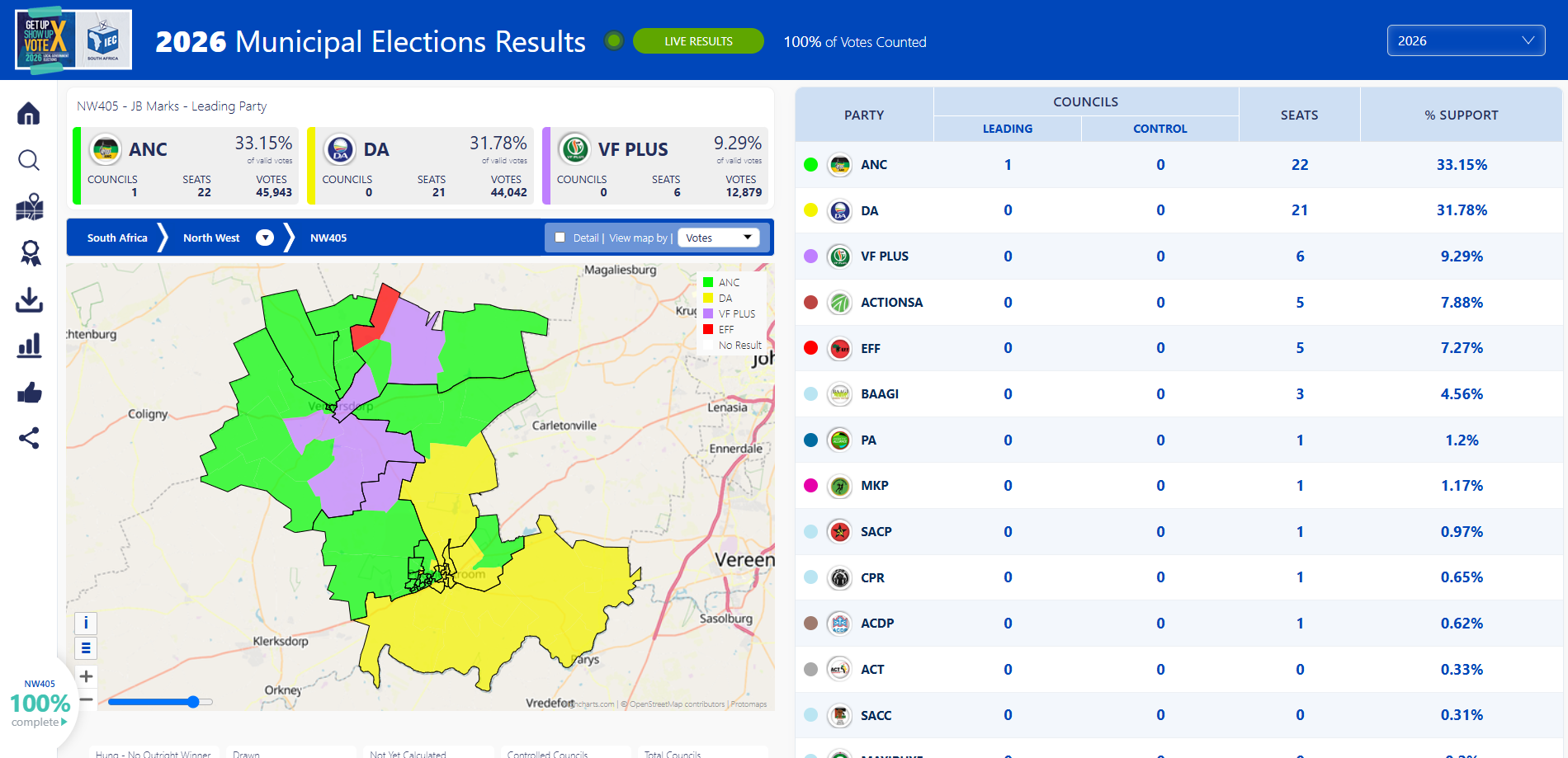
With 100% of the voting districts counted and certified, the official results establish a hung council where no single political party has secured an absolute majority of council seats
The conclusion of the 2026 Local Government Elections marks a defining moment in South Africa's democratic journey, shifting the spotlight from polling stations to municipal council chambers across the nation
The Rise of Hung Councils and Coalition Governance
One of the most consequential outcomes of the 2026 local elections is the widespread necessity for collaborative leadership
Prevalence of Divided Councils: Out of the 213 contested municipalities across South Africa, between 134 and 137 councils resulted in no single political party securing an absolute majority (more than 50% of council seats)
. The Mandate for Negotiation: In these hung municipalities, single-party dominance has been replaced by the imperative for multi-party agreements
. Cross-party negotiations will directly determine the election of key statutory office bearers, including the Council Speaker, Executive Mayor, and Members of the Mayoral Committee . Impact on Policy and Budgets: Coalition administrations require structured cooperation to ensure municipal budgets, integrated development plans (IDPs), and infrastructure delivery programs are passed without governance gridlock
.
Institutional Accountability: IEC Achieves 93% of Performance Targets
Alongside the final declaration of municipal results, the Electoral Commission of South Africa released its institutional performance review from the 2025/26 Annual Report, demonstrating high operational delivery standards
Overall Performance Score: The Commission achieved 93% of its planned targets set out under its Annual Performance Plan for the 2025/26 financial year
. Core Programmes Assessed: Performance accountability was measured across four primary functional areas, Administration, Electoral Operations, Outreach, and Political Funding
. Safeguarding Democratic Standards: The report underscores the importance of operational auditing, legal compliance, and ongoing institutional refinement, reaffirming the IEC's constitutional mandate to deliver transparent, accountable, and legally sound elections nationwide
.
How Municipal Council Seats Are Calculated and Formed
South Africa employs a mixed-member electoral model designed to balance direct, community-level representation with overall proportional fairness
Direct Ward Election: Each municipality is divided into geographic wards
. The candidate who secures the most votes on the Ward Ballot wins that seat outright, serving as the direct representative for their neighborhood community on the council . Proportional Representation (PR) Calculation: In parallel, all PR ballots cast across the municipality are tallied
. Applying a statutorily defined quota formula, the Electoral Commission calculates each party's total entitlement of council seats, ensuring their final share reflects their overall percentage of the popular vote . Constituting the Council: Once both ward and PR seats are allocated, the municipal manager convenes the newly formed council for its inaugural sitting
. Councillors take their official oaths of office, adopt standing rules of order, and conduct secret-ballot elections to appoint the Speaker and Mayor .
Voter Turnout and Municipal Summary
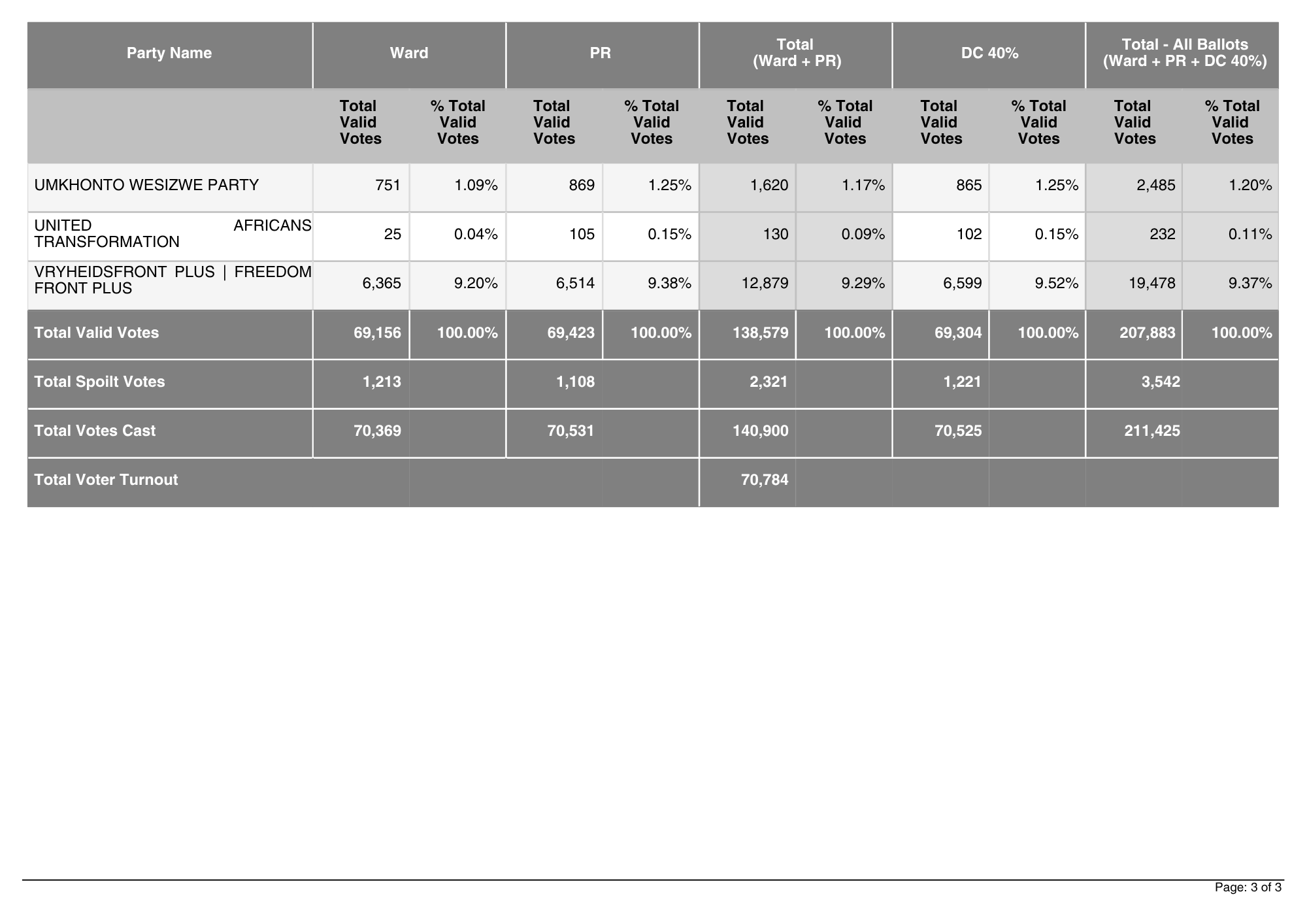
Electoral participation in JB Marks saw significant engagement across all wards, with voters receiving three ballots, Ward, Proportional Representation (PR), and District Council (DC 40%)
Total Voter Turnout: 70,784 voters participated in the election
. Total Valid Votes (Ward + PR): 138,579 valid votes were cast across the local ward and PR ballots to determine the direct composition of the council
. Overall Ballots Cast: Including the District Council ballots, a total of 207,883 valid votes were recorded
. Spoilt Ballots: A total of 2,321 spoilt ballots were recorded across the Ward and PR counts, with 3,542 across all three ballot categories combined
.
Percentage Support and Council Seat Distribution
The 67 council seats in JB Marks have been allocated based on the combined Ward and PR vote outcomes
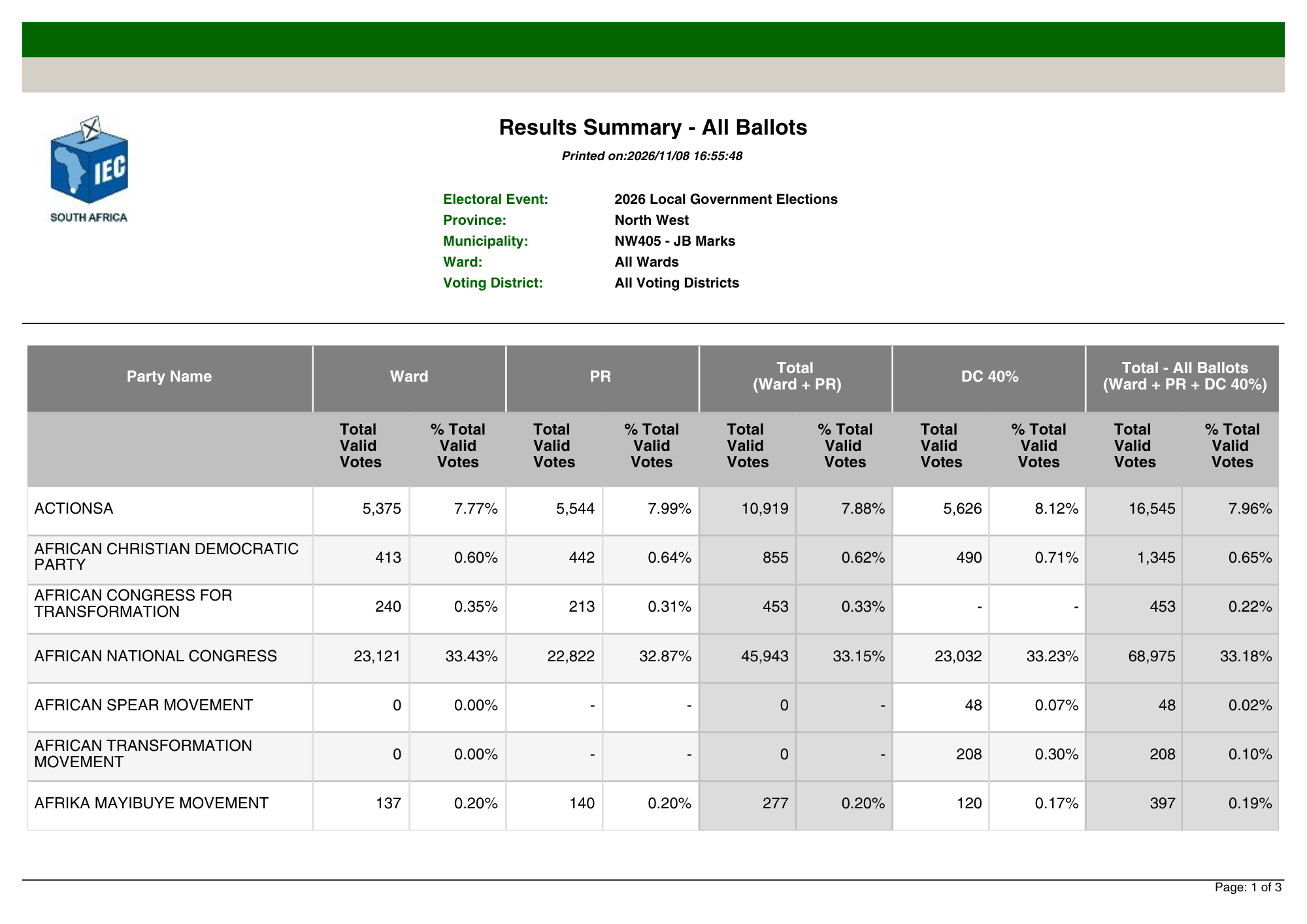
African National Congress (ANC): Secured 33.15% of the vote (45,943 votes), translating to 22 seats
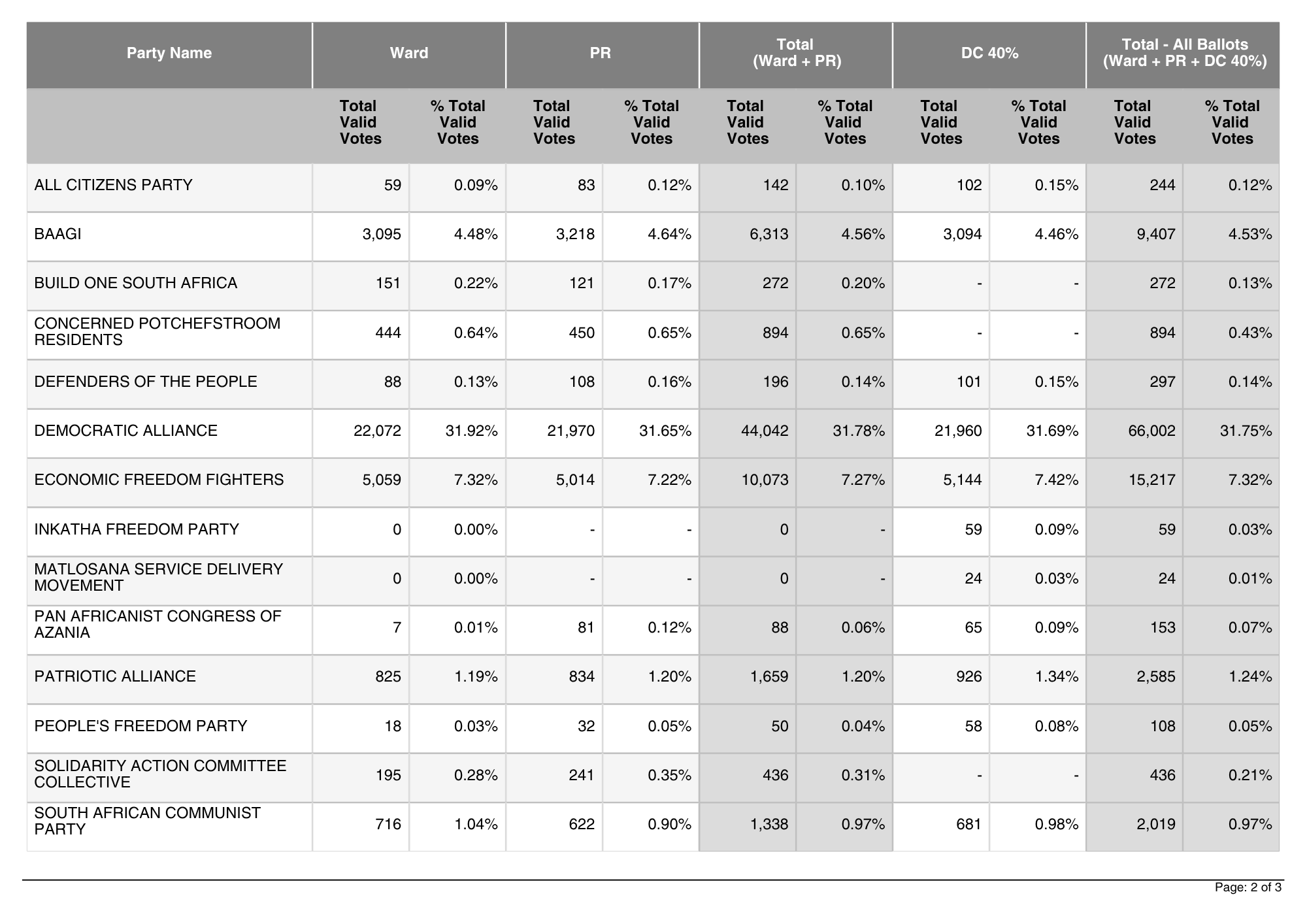
. Democratic Alliance (DA): Received 31.78% of the vote (44,042 votes), securing 21 seats
. Freedom Front Plus (VF Plus): Attracted 9.29% of the vote (12,879 votes), earning 6 seats
. ActionSA: Obtained 7.88% of the vote (10,919 votes), gaining 5 seats
. Economic Freedom Fighters (EFF): Captured 7.27% of the vote (10,073 votes), securing 5 seats
. Baagi: Won 4.56% of the vote (6,313 votes), earning 3 seats
. Patriotic Alliance (PA): Garnered 1.20% of the vote (1,659 votes), securing 1 seat
. uMkhonto weSizwe Party (MK Party): Recorded 1.17% of the vote (1,620 votes), securing 1 seat
. South African Communist Party (SACP): Received 0.97% of the vote (1,338 votes), winning 1 seat
. Concerned Potchefstroom Residents (CPR): Secured 0.65% of the vote (894 votes), earning 1 seat
. African Christian Democratic Party (ACDP): Received 0.62% of the vote (855 votes), gaining 1 seat
.
Smaller parties and independent contestations that received less than the quota did not qualify for a seat allocation
Regional Context: JB Marks Within the North West Province
The outcome in JB Marks mirrors a broader regional shift toward contested, split councils across the North West province
Provincial Lead: Across North West, the ANC led in 17 municipal councils and achieved outright control in 7, winning 370 seats (44.05% of valid provincial votes)
. Opposition Representation: The DA secured 109 seats (14.30%), the EFF gained 97 seats (12.46%), ActionSA earned 57 seats (6.51%), the SACP won 32 seats (4.21%), and the VF Plus took 30 seats (3.98%) across the province
. Local Balance: Within JB Marks specifically, the margin between the two leading parties was notably narrow, separated by just 1.37 percentage points (1,901 votes) and a single council seat
.
Council Formation and Coalition Realities
With 67 total seats in the JB Marks municipal chamber, a governing majority requires at least 34 seats
First Council Sitting: Within the statutory period following the declaration of results, the municipal manager will convene the first meeting of the newly elected council
. Election of Office Bearers: Councillors will be sworn in to cast secret ballots for the positions of Council Speaker, Executive Mayor, and Council Whip
. Executive Governance: The resulting governing coalition or co-governance agreement will oversee municipal budgets, approve strategic integrated development plans (IDPs), and direct service delivery for Potchefstroom and Ventersdorp communities over the next five-year term
.
The final declaration of results concludes the electoral operational phase and transfers responsibility to the newly elected council representatives to build collaborative leadership, maintain civic oversight, and deliver municipal infrastructure and basic services to all residents of JB Marks
#JBMarks #LGE2026 #ElectionResults #Potchefstroom
🗳️📊🏛️