National News
Dont kill the soul of rugby
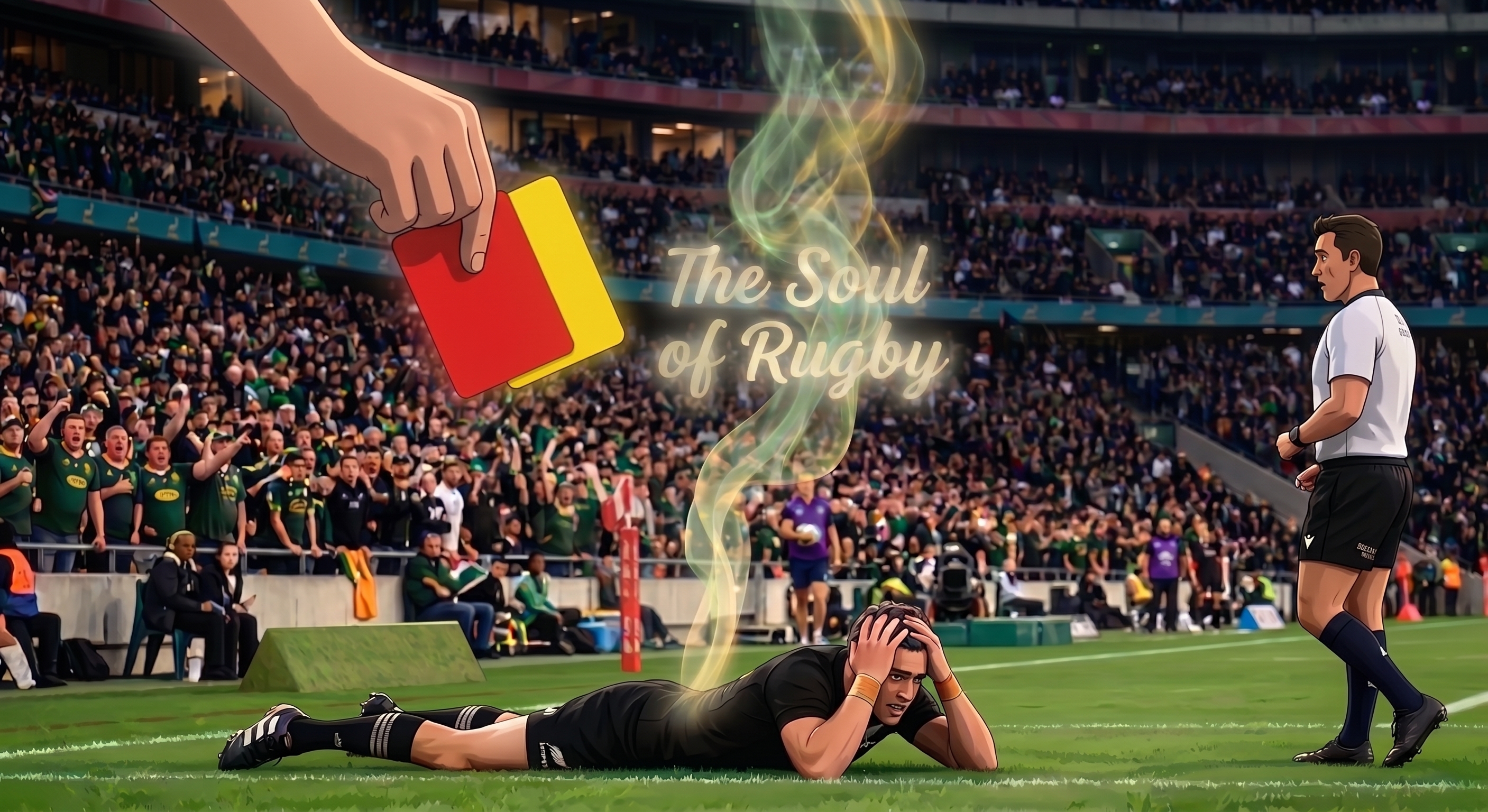
Saturday at FNB Stadium gave us one of the great Test matches. The Springboks beat the All Blacks 29-24
The series sits at 2-1 with one to play in Baltimore, and the game had everything: a scrum that got dismantled, a penalty try, a finish that went to the last play. It should be the only thing we are talking about.
Instead we are talking about Cam Roigard lying on the turf holding his head.
What happened
Referee Nika Amashukeli had already blown for a penalty try after the All Blacks scrum went backwards. Roigard, either not hearing the whistle or ignoring it, grabbed hold of Cobus Reinach at the base of the scrum. Reinach did what most scrumhalves would do to a man hanging onto him after the whistle: he ripped him off and flipped him over. Roigard landed on his side. His head did not hit the ground.
Then the acting started. Roigard clutched his head and stayed down. The officials went to the screen. The verdict was a penalty to New Zealand and no card for Reinach, which tells you the referee saw exactly what the rest of us saw. Reinach was rough. He was not dangerous. Roigard was trying to turn a shove into a red card.
Jean de Villiers, on commentary, called it what it was. He said the game runs on pride and that a dive has no place in it. Ben Youngs and Dan Cole, no friends of South Africa, went further on their podcast and put Roigard's habit of lying down next to the names of Dupont and Gibson-Park and said you would never see those players do it. That is the damning part. The criticism is not coming from bitter Bok fans. It is coming from the men who have played the position at the highest level.
And it is a habit. In this year's Super Rugby semi-final between the Hurricanes and the Blues, Roigard went to ground taking a high ball, the Blues players stopped because they thought he needed treatment, and he bounced up and took a quick tap. Once is an accident. Twice is a method.
We have been here before
Cast your mind back to Adelaide Oval, 27 August 2022. Rugby Championship, Wallabies against the Springboks, 39th minute. Faf de Klerk went to slap the ball out of Nic White's hands at the back of a five-metre scrum and his fingers brushed White's face. Brushed. Not punched, not elbowed. White looked up at the referee, then dropped to his knees like he had been hit with a fire extinguisher.
Paul Williams went to the TMO and sent Faf to the bin. Faf laughed as he walked off, because what else do you do. Australia went on to win 25-17 and the yellow card swung the game.
The reaction then was the same as now. John Smit said White had "killed a little piece of rugby's soul". Butch James called it a disgrace to the game. Even the Australian pundits were embarrassed: Sean Maloney called it one of the softest yellow cards of the year. Nobody defended it. Even Will Genia, White's own former team-mate, said the criticism of Whitey was warranted and that the officials made it worse by rewarding him.
Four years later the man doing the diving wears black instead of gold, and we have learned nothing.
Why this matters more than one penalty
Rugby sells itself on one thing that football cannot: you take the hit and you get up. It is the entire deal. A prop who has just been folded in half at scrum time does not roll around asking for a card. A wing who gets clattered in the air gets up because the alternative is admitting weakness in front of his team. That culture is the product. It is why parents in Potchefstroom and Palmerston North both put their kids in the sport.
Simulation eats that from the inside. Every time a dive wins a card, three things happen. The referee, who now has the TMO and a slow-motion replay, gets pushed toward the harshest reading of every contact. The player who did nothing wrong loses ten minutes, or the match, or a suspension. And the next scrumhalf watching from the couch learns that lying down works.
It also shifts the game's centre of gravity away from the field and onto the screen. Saturday's Test had 80 minutes of brutal, honest rugby and the talking point on Monday is a piece of theatre that happened after the whistle. That is Roigard's doing, not Reinach's.
What should happen
Three things, and none of them are complicated.
1. Referees deal with it on the field. Youngs said it plainly: the referee has to grab hold of it and say we are not having it. Nigel Owens used to do this with a look and a sentence. If a player goes down clutching a body part that was never touched, that is a penalty against him for feigning, and the referee should say so on the microphone so the stadium hears it.
2. Citing commissioners cite it. World Rugby's laws already cover unsporting behaviour. If a lifted tackle gets reviewed for a week after the game, a fake head injury can be too. One retrospective sanction and the behaviour stops.
3. Coaches own it. Dave Rennie was in charge of the Wallabies in Adelaide in 2022 and he is in charge of the All Blacks now. Both of his scrumhalves have done this on his watch. He does not have to answer for it publicly, but he should be answering for it in the team room.
Cam Roigard is a very good rugby player. His passing and his kicking game are top three in the world at nine. He does not need this. The Boks did not need it in 2022 and the All Blacks do not need it now. Get up, get on with it, and let the rugby do the talking. That has always been the deal.